Rules · PHW99Verse
Multipliers: Read the Base Before the Number
The symbol × is compact; the sentence explaining it may not be. A label such as 3× leaves an essential question unanswered: three times what? To read a multiplier statement carefully, find the base amount, the stage at which it applies and the rule for combining it with other labels. The arithmetic below uses invented points, not a real game’s paytable.
A multiplier needs a base and a timing rule. Do not combine two multiplier labels until the named rules explain whether they add, multiply or apply to different amounts.
Find the base
In the sentence “multiply this 5-point subtotal by 3”, the base is the 5-point subtotal and the result is 15 points. Remove “subtotal” and you lose a boundary: the reader cannot tell whether the multiplier applies to one item, a group of items or something else. When a game uses a labelled value such as a line award or a feature total, keep that label in your notes.
A large multiplier printed in artwork cannot supply the missing base on its own.
Read the verb between multiple labels
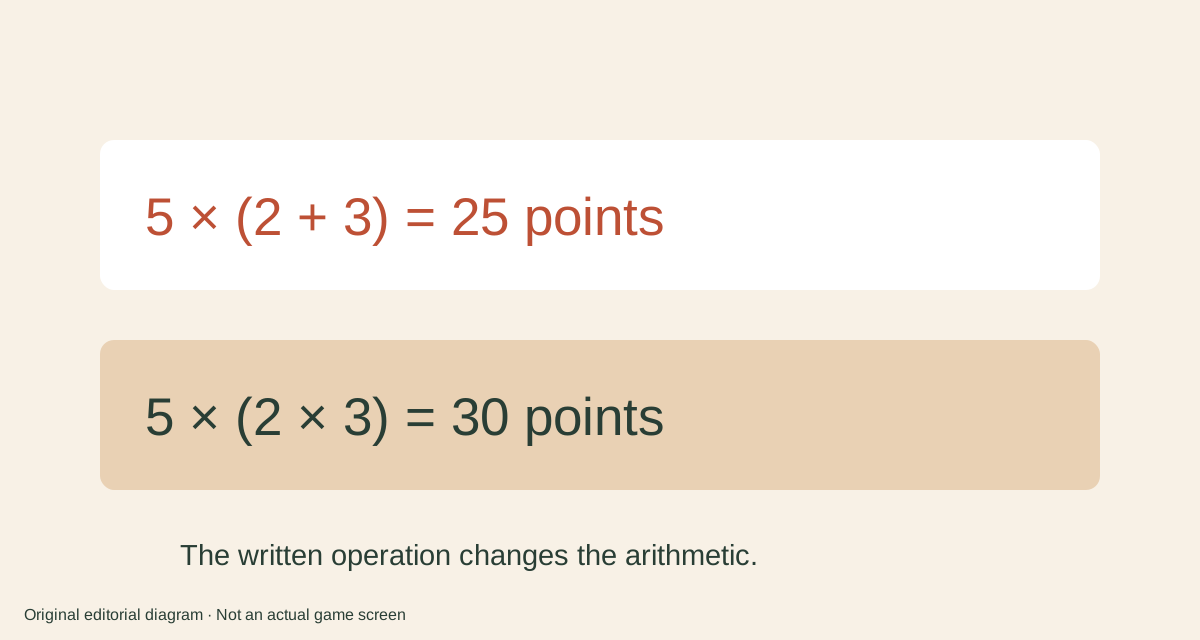
Suppose the invented example contains 2× and 3×. If the instruction says add the multiplier values before applying them, the combined factor is 5. If it says multiply the factors, the combined factor is 6. Applied to the same 5-point base, these would produce 25 and 30 points. These are two deliberately different instructions, not competing interpretations of an unspecified game.
Our diagram places the verb next to the numbers so the difference is visible without relying on colour.
A specific source can define a specific sequence
Pragmatic Play’s Sweet Bonanza description says that values on feature multiplier symbols are added together at the end of the tumbling sequence. That is a named example of an explicit combination and timing statement. It does not establish the combination rule for another title, an updated edition or a remote installation that has not been checked.
Use the source to answer the narrow question it actually addresses, and preserve the feature context when summarising it.
Timing can change what a sentence includes
Words such as “during”, “after”, “at the end” and “for this feature” decide which part of a process is being described. In a fictional worksheet, a factor applied after adding two subtotals is a different instruction from one applied only to the second subtotal. Write the sequence in plain language before doing arithmetic. If the source does not specify it, record that missing step.
Numbers alone cannot resolve a missing timing rule, and animation order is not a substitute for a written definition.
Leave frequency and limits as separate claims
A multiplier’s possible value does not establish the chance of receiving it. It also does not, by itself, state the overall maximum award, the number of eligible events or the way a limit interacts with a feature. Read each of those as a separate source-backed claim rather than treating a big label as a complete specification.
For your final note, use four fields: base, operation, timing and limit. Fill only what the named source establishes. The reading glossary keeps those terms together, while the numbers note explains why an amount is not a frequency.
Your reading checklist
- Base named
- Combination verb found
- Timing condition retained
- Limits read separately
- Frequency not inferred from value
Reader questions
Do multiplier labels always multiply one another?
No universal operation follows from two labels alone. The written rules must define how they combine in the named context.
Does a possible multiplier tell me its probability?
No. Possible value and likelihood are separate pieces of information.
Sources and scope
- Pragmatic Play — Sweet Bonanza official product page
The named original title’s public description, including tumbling symbols and the described feature multipliers.