Features · PHW99Verse
Wild and Scatter: Read the Role, Not the Artwork
A glowing tile, a character portrait and the word WILD can attract attention for different reasons. Their appearance does not supply a universal rule. For an English-language reader, the useful task is to connect each symbol name to the sentence describing its function in the exact title being discussed. This note separates that reading task from assumptions about frequency or outcomes.
A symbol’s artwork identifies it visually. Its rule explains its job. Read the permitted substitutions, exclusions and feature conditions before applying a familiar label.
Read the function as a complete sentence
When a source calls a symbol Wild, look for what it can replace and what it cannot. Preserve any qualifying words attached to that statement. A symbol described as a Scatter may instead be discussed in connection with a trigger or a separate award. Those labels do not, by themselves, tell you whether a symbol pays, where it appears or how it interacts with another feature.
Rather than writing “Wild does everything”, use a record with three fields: role, exception and condition. A missing field stays blank until a source establishes it.
A named example keeps the explanation honest
Pragmatic Play’s dated Wild West Gold announcement describes a Wild multiplier, a Scatter-triggered mode and Sticky Wilds during Free Spins. These are several separate statements about a named title, not an interchangeable definition of every special symbol. The announcement is historical source material dated 26 March 2020; it is not a check of a current remote installation.
Notice how the timing word matters: a condition applying during a feature should not be copied into a sentence about all ordinary outcomes.
One illustration can show roles without simulating play
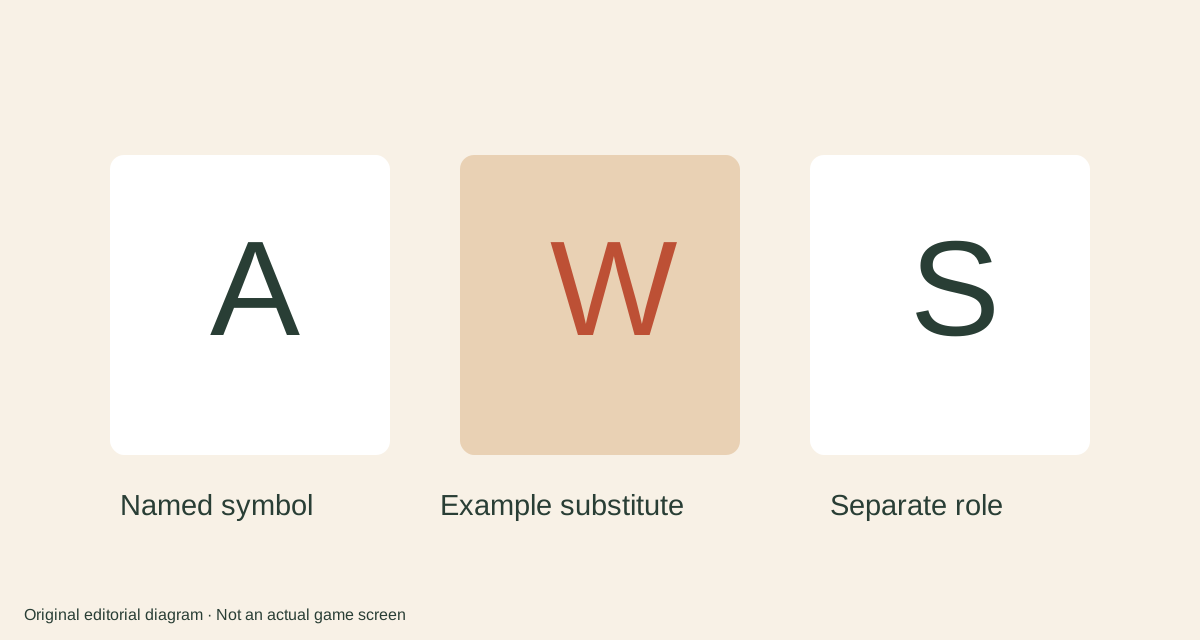
Our diagram uses the invented labels A, W and S. In its example sentence, W may stand for A, while S is labelled separately as a trigger marker. This is an illustration of how to read two different roles. It does not reproduce the rules, layout or payout of a real game, and it includes no probability or award amount.
The distinction survives even if you change the artwork. Replacing a star with a diamond would not change the example’s written condition; removing the condition would make the example incomplete.
Watch for a second job
A symbol or an ordinary symbol chosen during a feature may gain a specifically described role. Play’n GO’s Book of Dead product page discusses a Special Expanding Symbol within its Free Spins description. That example is a reminder to follow the named feature’s conditions rather than treating a familiar icon as a complete explanation.
A useful note distinguishes the original symbol, its additional role, when that role starts and what the source says about when it ends.
Keep frequency out of a role definition
A description of what a symbol does is not a statement of how often it appears. The same is true of trigger counts: a count in a condition does not provide the probability of satisfying it. Avoid replacing missing probability information with a small set of screenshots or an impression from an animation.
Finish with a small question: “Which sentence defines this role in this title?” If you cannot answer, keep the label as a visual observation and leave the behaviour unconfirmed. Read the screenshot evidence note for a way to record that boundary.
Your reading checklist
- Name the symbol
- Copy the permitted role
- Retain the exception
- Retain the feature timing
- Do not infer frequency
Reader questions
Is a Wild always excluded from replacing a Scatter?
Do not treat that as a universal rule. Read the explicit substitution and exclusion statements for the named title.
Can a symbol’s role change in a feature?
A source may describe an additional feature-specific role. Keep the timing and conditions attached to that explanation.
Sources and scope
- Pragmatic Play — Wild West Gold release announcement
Dated 26 March 2020; examples of a Wild multiplier, Scatter trigger and Sticky Wilds for this named title.
- Play’n GO — Book of Dead official product page
The named title’s Expanding Symbol feature; no inferred RTP, licensing or configuration for an operator.